I recently met with a business leader who was interested in xFLOWer.
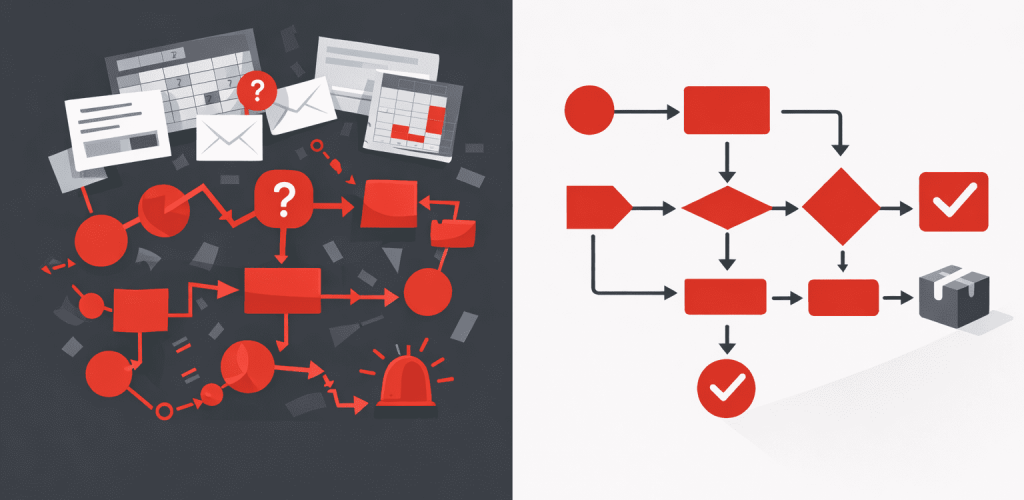
His problem may sound familiar to anyone who has ever tried to run a complex sales process “manually” using Excel, emails, and a little hands-on experience.
The task seemed simple
He called it a CRM, but as we will see, a CRM solution does not cover the functionality he needed.
From the outset, he described sales as a process: from the initial meeting and sample approval through production to the delivery of finished products, everything needs to be visible, tracked, and managed. Add a little inventory management, so you do not discover you are out of stock just as a customer places a repeat order and is already waiting at the door.
Nothing resembling “space technology,” just a process-based system that works. A common request for us :).
They had already tried before
After almost a year of development, an IT company delivered a CRM application. The only problem was that they could not use it for even a minute.
Not because it still needed some fine-tuning, but because it could not perform even the basic tasks expected of it.
It was like a beautiful car that simply would not start.
When the demo works, but the price stops you
During the meeting, I demonstrated a few xFLOWer workflows. The reactions were positive throughout:
- “This is exactly how we think.”
- “Now, this is clear and easy to follow.”
- “Finally, something that manages tasks within a single system.”
Then we came to the pricing.
And that was when the human equivalent of a system freeze occurred: disappointment and shock appeared on the business leader’s face.
When he saw our prices—which are publicly available, incidentally—the room suddenly went very quiet.
Then came the classic argument:
“The previous company charged much less than this.”
Only one question remained
I responded with just one question:
– And did it work?
The silence continued.
Because at that point, we are no longer talking about software. Or licenses. Or hourly rates.
We are talking about:
- the cost of a year of wasted time,
- the cost of an application that does not work,
- the cost of managers trying to run operations manually, using Excel and emails (spoiler: it is substantial).
What is truly expensive?
Price is not the only thing that distinguishes a cheap system from a more expensive one. What makes it expensive is its failure to solve the problem it was created to address.
So the real question is not “how much does a system cost?” but how much it costs if it still does not work.
The xFLOWer philosophy
The xFLOWer philosophy is simple: rather than offering “software for everything,” we first get the process right, then automate whatever we can within a single application.
Because in the long run, a clear, transparent system that works is not the expensive option. The one that does not work is.