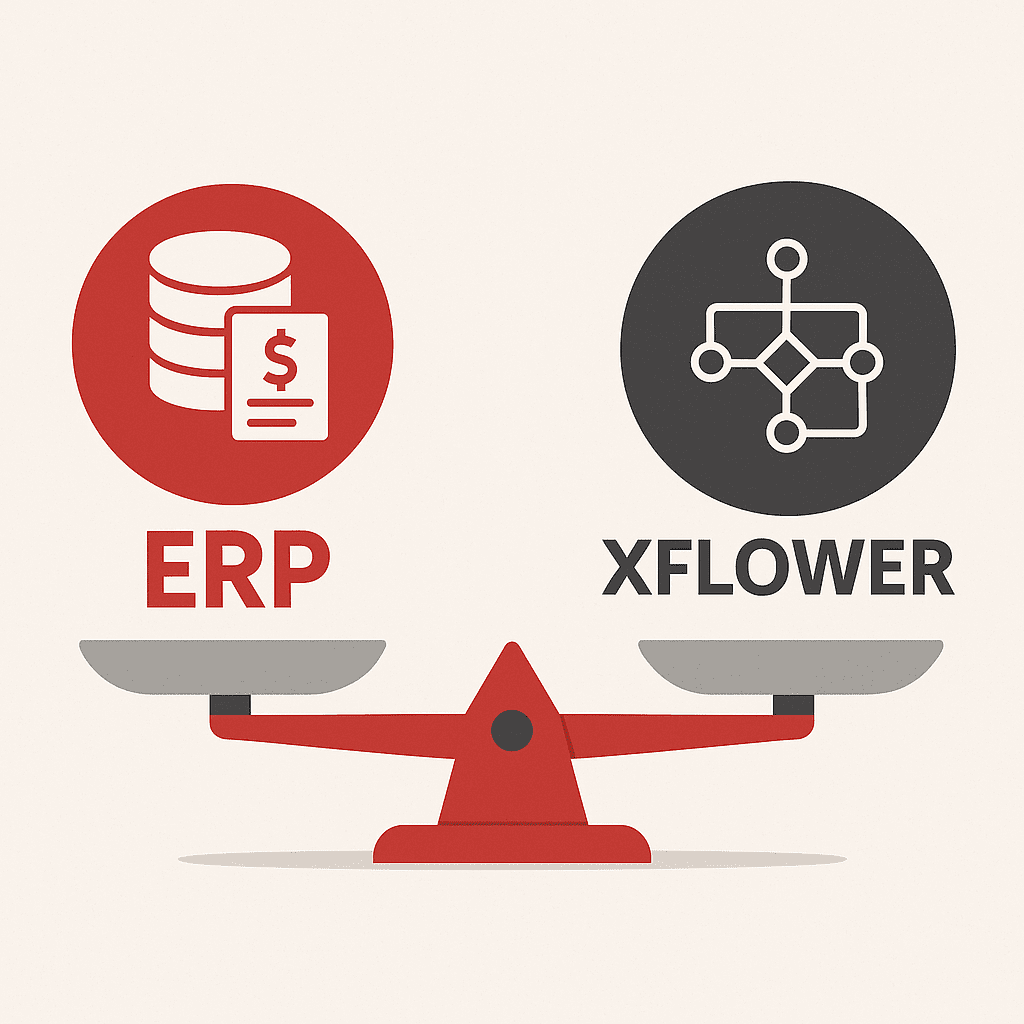
When ERP no longer answers the questions of day-to-day operations
At an industry event, I was talking to a former colleague, and we quickly arrived at a situation familiar to many business leaders today. Their company has an established ERP system that they are generally happy with. Finance runs smoothly, records are in order, and administration is predictable. Yet they still felt something was missing. Day-to-day operations, tracking tasks, clarifying responsibilities, and resolving bottlenecks still require a great deal of manual coordination. Emails, phone calls, separate lists, and ad hoc follow-ups hold together what should really be managed within a system. In my view, this is where it becomes clear why ERP alone is not enough for many companies.
ERP and xFLOWer address different challenges
In my experience, ERP and xFLOWer address two distinct operational needs. ERP provides an excellent foundation for a company's record-keeping and administration: it captures data, makes it retrievable, and provides a stable framework. xFLOWer comes into play where day-to-day operations go beyond basic data management. Where approvals are needed, tasks move between people, decisions are made, and everyone needs to see where things stand. I often put it this way: ERP shows what has happened in the company, while xFLOWer helps processes run more smoothly from start to finish. For a business leader, visibility after the fact is not enough. They also need control while work is in progress.
What does xFLOWer add to your existing system?
This is precisely why I believe xFLOWer's real strength lies in complementing existing systems. Rather than adding another burden to the organization, it brings order to processes that are currently fragmented. A workflow-based approach makes it possible to track who initiated a task, who has it now, how long it has been waiting, where it is stuck, and what the next step is. This is where digitalization finally delivers tangible benefits in day-to-day operations. We see not just that we have data, but that the company is becoming better organized. I believe this is exactly what many business leaders are looking for, even if they express it differently: less firefighting, less chasing things up, and less dependence on specific individuals.
In short: there is no need to choose between the two
Ultimately, I do not see this as an ERP-versus-xFLOWer dilemma. Instead, I see two systems that can work particularly well together. ERP provides a stable foundation for enterprise management, while xFLOWer supports day-to-day operations and makes processes more transparent. When companies recognize this, digitalization no longer stops at system implementation. It begins to deliver real efficiency gains that can be felt in everyday operations. To me, this is xFLOWer's most important added value: it helps ensure that business operations are not just documented, but also organized, traceable, and easy for leaders to manage.
What should you consider?
If your ERP is working well but daily coordination still takes up a lot of time and effort, it is worth exploring where xFLOWer could help. A brief conversation can quickly identify where xFLOWer can provide meaningful support alongside your existing ERP in terms of workflows, responsibilities, and operational visibility. And if you would first like to assess your company's current level of digitalization, consider completing this anonymous digital maturity test: https://digital-maturity.xflower.ai/.
And if you would first like to assess your company's current level of digitalization, consider completing this anonymous digital maturity test:
https://digital-maturity.xflower.ai/