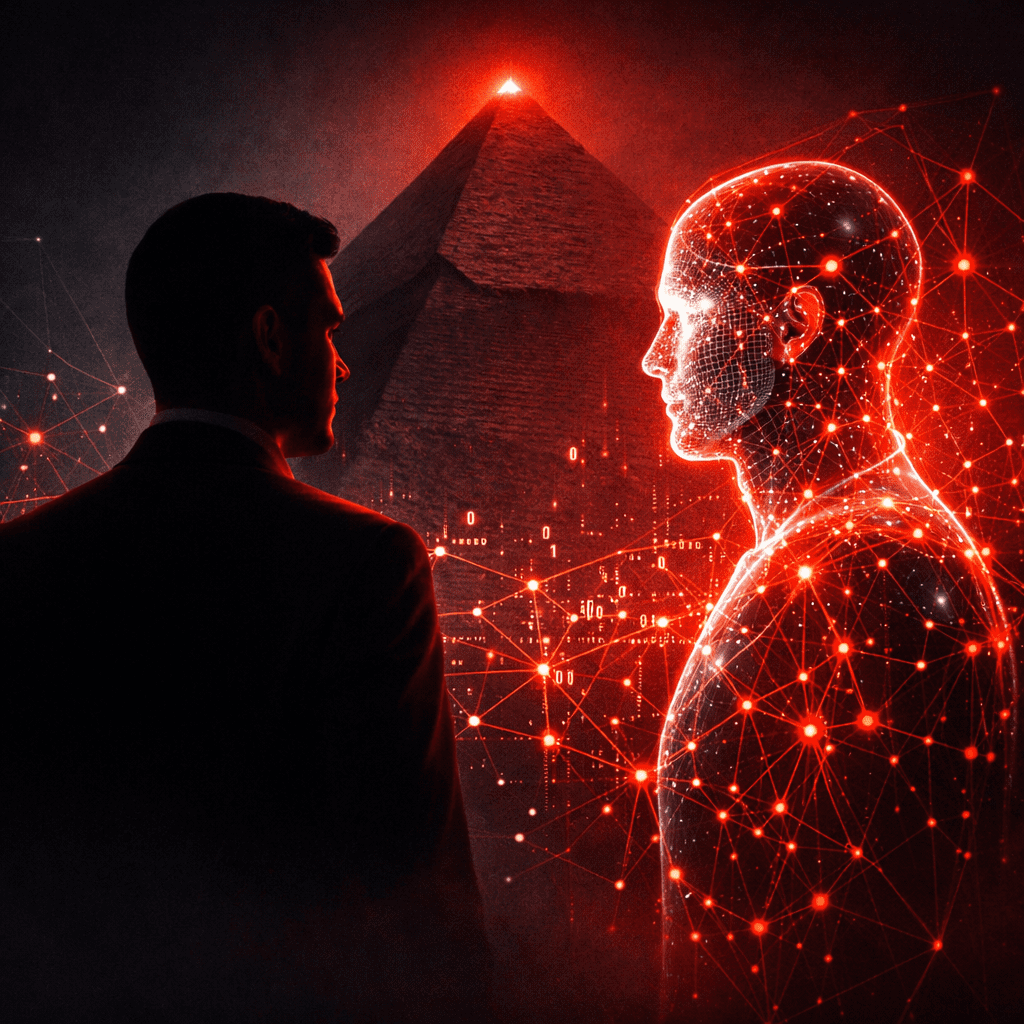
I recently attended an event where we discussed how digital twins could be applied to leadership. The question was provocative:
Is it possible—or will it be possible in the future—to build a digital counterpart alongside a leader?
Not to replace them. But to provide oversight, reflection and support.
The discussion took a particularly interesting turn when an idea emerged that many still find uncomfortable today: to what extent is what a leader calls “intuition,” “experience” or “leadership instinct” actually the result of structured patterns, learned behaviors and data-driven decision mechanisms?
And if not the leader, what about their middle managers?
Ask a chief executive how far their middle manager could be replaced by a well-trained digital system, and the response is often much more open.
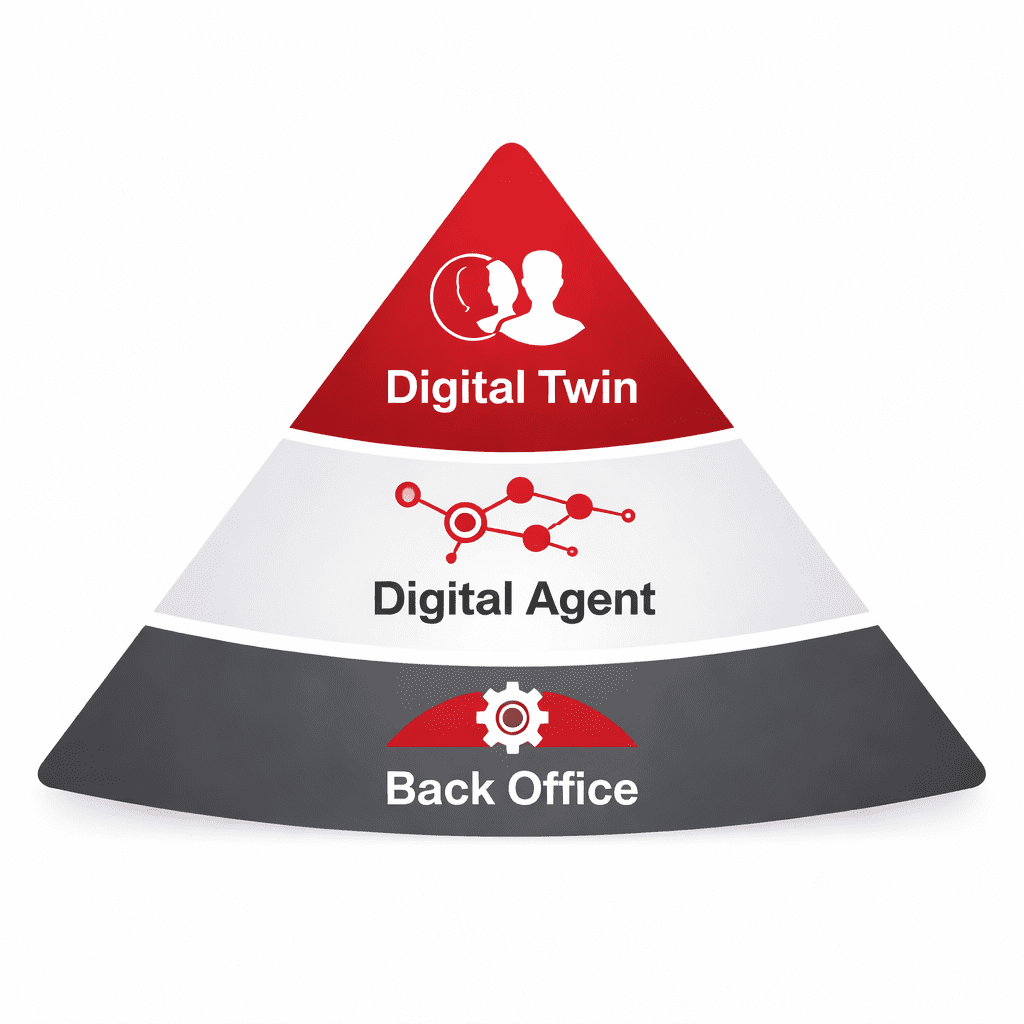
However, this dilemma can only be properly understood if we distinguish between three concepts that are often conflated:
- Digital Twin
- Digital Agent
- Back Office Automation
They do not mean the same thing. They do not play the same role. And they do not address the same problem.
The industrial roots of digital twins—when building a parallel world is straightforward
The concept of the “digital twin” originated in manufacturing.
There, the situation is relatively straightforward: a digital replica can be created for a physical asset—a production line, a machine or a production process. The digital twin:
- models its condition,
- simulates its behavior,
- predicts failures,
- optimizes operations.
Before replacing a component in the real world, we can run a simulation in the digital environment.
Machines do not take offense, have no intuition and are not attached to familiar ways of working.
That makes the digital twin a natural and highly effective tool in manufacturing.
But what happens when the “production line” consists of people rather than machines?
A leader’s digital twin—a mirror or a replacement?
In an organization, people stand behind the processes. Along with decisions, interests, informal power structures and cultural patterns.
Here, a technical simulation is no longer enough.
A leader’s digital twin is more than just a data model. It involves:
- mapping their decision-making patterns,
- modeling their priorities,
- analyzing their risk-taking profile,
- reproducing their communication style,
- understanding the organizational environment in which they operate.
And this brings us to the key question:
- Does this replace the leader?
From a professional standpoint, the answer is clear:
- no.
A well-built digital twin does not replace. It reflects.
- It provides an oversight mechanism.
- A preliminary filter for decisions.
- A simulation environment.
It helps answer questions such as:
- What would happen if?
- What might the consequences be?
- What pattern does my decision follow?
- Is this really intuition, or a recurring pattern?
This support, however, is still different from an agent-based system.
At a startup conference, I encountered an entirely different perspective.
The room was filled not with conservative corporate executives, but with young founders building agent farms.
And this was not about theories, but very concrete, tangible demonstrations.
When the presenter showed how an agent had worked through real estate market data, the entire room understood at once that this was not a vision of the future drawn on a slide: within minutes, the system had shortlisted neighborhoods, compared rental rates with traffic data and returned three locations—each with a risk note and a suggested next step. All two people had to do was review the results and decide: “go” or “no go.”
They are building systems in which:
- agents generate business ideas,
- agents seek venture capital to fund them,
- agents negotiate real estate deals,
- agents procure raw materials,
- agents optimize technology,
- agents build the marketing function,
- agents organize logistics and sales processes.
One specific example was presented:
a vertical radish farm established in a metropolitan office building, with its financing, supply chain, nutrient optimization and sales system largely designed by agents.
Two people oversee it.
But digital entities built the operation.
This is no longer a digital twin.
It is a digital agent ecosystem.
An agent does not reflect.
It does not model.
It acts.
Back office automation—the foundation layer
Most organizations, however, have not yet reached the stage of leaders’ digital twins or agent farms.
Instead, they are working to make:
- invoice processing,
- reporting,
- data entry,
- contract generation,
- status updates
automatable.
This is back office automation.
It replaces repetitive, rules-based administrative processes.
- It is important.
- Necessary.
- Cost-effective.
- But it is not strategic intelligence.
- It is not decision-making.
- It is not a digital mirror of the organization.
- It is the foundation layer.
- The infrastructure.
The differences between the three levels
| Level | Purpose | What does it take on? | Human role |
|---|---|---|---|
| Back Office Automation | Operational order | Repetitive administration | Oversight |
| Digital Agent | Action + preparation | Complex processes | Strategic direction |
| Digital Twin | Reflection + oversight | Decision-making patterns | Final decision |
The most important insight:
we are not talking about the same thing.
And we are not addressing the same fears.
The sequence of progress—you cannot build in reverse
Progress cannot be built in reverse order. Without back office automation, there are no agents, and without agents, there is no digital twin.
But this does not mean that back office automation becomes less valuable at a more advanced stage of development—the digital twin stage.
It is like a pyramid. Its top is small, but it stands on a vast foundation that narrows layer by layer. The bottom layer is the widest, and it is usually where the hidden tunnels and treasures are to be found.
Digital replacement? An unnecessary destination
This raises a question: does the digital twin lead to digital replacement, where humans are no longer needed?
I do not believe so.
The real leadership dilemma
Most leaders believe their work cannot be reduced to algorithms.
And they are right—to an extent.
But the question is not whether they can be replaced.
It is whether their work can be:
- modeled,
- mirrored,
- optimized,
- subject to oversight.
An organizational digital twin does not replace the leader.
It makes the organization’s operations visible.
An agent system does not replace the entrepreneur.
It scales their thinking.
Back office automation does not replace the employee.
It frees up their time.
The question for the next five years
Digital twins are already commonplace in manufacturing.
Agent farms are already commonplace in the startup world.
Traditional companies are now taking the first step.
The question is not which technology will win.
It is at which level the organization can think about itself:
- Operational efficiency?
- Autonomous digital action?
- A mirror for leadership decisions?
The digital future is not about a single tool.
It is about layers.
And the most interesting layer is not automated administration.
Nor is it the agent farm.
It is the moment when a leader first faces their own digital twin—and realizes that the patterns behind their decisions have become visible.
That is where real transformation begins.
Digital transformation becomes meaningful when a leader first gains insight into the patterns of their own thinking.