Background to the Market Research
This market research was commissioned from an external partner by Click On Hungary Kft., the developer of the xFLOWer system. The aim was to provide our potential customers with an objective overview of software providers specializing in workflow and process automation.
Further information on the background to the research and a summary of the methodology can be found in the introductory article in this blog series.
Scope
Categories
- Hungarian market players
- Work management
- Enterprise workflow
- Low-code / no-code
Comparison Criteria
- Features
- Infrastructure
- Pricing approach
- Public pricing / custom quote
- Pricing model
- Free trial
- Platform (desktop, web, mobile app)
Further information on the scope and terminology used can be found here.
Hungarian Workflow Software
What does the Hungarian market offer when we entrust process automation to local providers?
In our previous article, we explained why we cannot make a truly “apples-to-apples” comparison. As a first step toward addressing this issue fairly, we have separated Hungarian providers from international software vendors. This certainly does not imply a difference in quality—quite the opposite. Several Hungarian providers serve customers across borders, including in multiple locations around the world.
The order of the solutions reviewed does not reflect any preference or ranking; instead, we have sought to arrange the providers by size.
Oriana
Oriana International Zrt. began operating in 2002, then entered a period of significant growth and expanded internationally following an investment by Hiventures in 2019. The well-known global research and advisory firm Forrester classifies its solution, Oriana, among Prescriptive Low-Code Application Development platforms. Its value proposition is that users can create a variety of business applications without extensive software development expertise, potentially within just a few weeks. Oriana thus enables businesses to avoid the lengthy work, time requirements and costs associated with custom development, without having to rely on the limited functionality of off-the-shelf solutions.
The platform offers “ready-made solutions” for several key business processes, which users can customize as needed, or they can build their own business applications entirely from scratch. These areas include procurement, contract management, records registration, HR and compliance.
The platform offers users three key tools. Oriana Studio, for mapping data models and business processes, and Oriana Blocks, which collects developers’ source code in a library, constitute its no-code tools, while Oriana Engine, which uses an SQL database, is offered as its low-code solution.
Although it forms part of the overall Oriana platform, the software vendor presents its workflow tool as a separate feature, enabling users to model business processes and configure related deadlines and permissions. The platform provides an exceptionally simple, clean user interface for this purpose, where individual process steps can be edited using “drag&drop” functionality, by dragging them into the graphical process editor. Process editing is also made easier by Oriana’s use of BPMN 2.0 standards in its graphical editor, allowing every custom process to be built according to an internationally accepted framework.
Of course, compared with custom development, a low-code / no-code platform requires a compromise: the visual appearance of the business application is based on a predefined template. Oriana, however, offers a wide selection of these. We can define the menu items visible to users, including submenus, and control what is displayed based on permissions. Tasks, for example, can be presented in a Trello-like layout divided into sections, so users always have a clear view of what they need to do.
Another strength of the platform is that building data models within the system enables a wide range of reporting options, presented through the clean, easy-to-use interface that characterizes the entire system.
It is also worth mentioning that, according to the vendor, the solution offers ready-made integrations with various business applications and can, of course, be connected to any enterprise management system through custom integration.
Unfortunately, Oriana does not offer a free trial or publish a price list on its website. Based on our experience, this suggests that Oriana is primarily intended for enterprise environments, where the solution provider can quote potential customers only after an initial assessment. Such proposals presumably also include customer references, which are likewise not publicly available, although they would make it considerably easier for interested businesses to gather information. Nevertheless, the investor backing the developer, last year’s revenue of HUF 336 million and its 31 employees provide assurance that anyone choosing Oriana is selecting a solution with extensive functionality that is modern even by international standards.
Workflowgen
We are making a small exception with our next provider, as we promised to examine Hungarian-developed solutions in this category. Workflowgen was developed by Advantys, founded in Montreal, Canada, in 1995. However, it has dedicated representation in Hungary through a reseller and implementation partner, earning it a place in this category. EastFlow Technology Kft. has specialized in business process automation since its establishment in 2003. With 15 employees and revenue of HUF 303 million last year, it is a significant player in Hungary’s workflow market. As a Workflowgen reseller, EastFlow not only implements the software in Hungary but also localizes it, adds its own modules (EastDoc, FileFolder, EastReport Plus) and provides process management consulting.
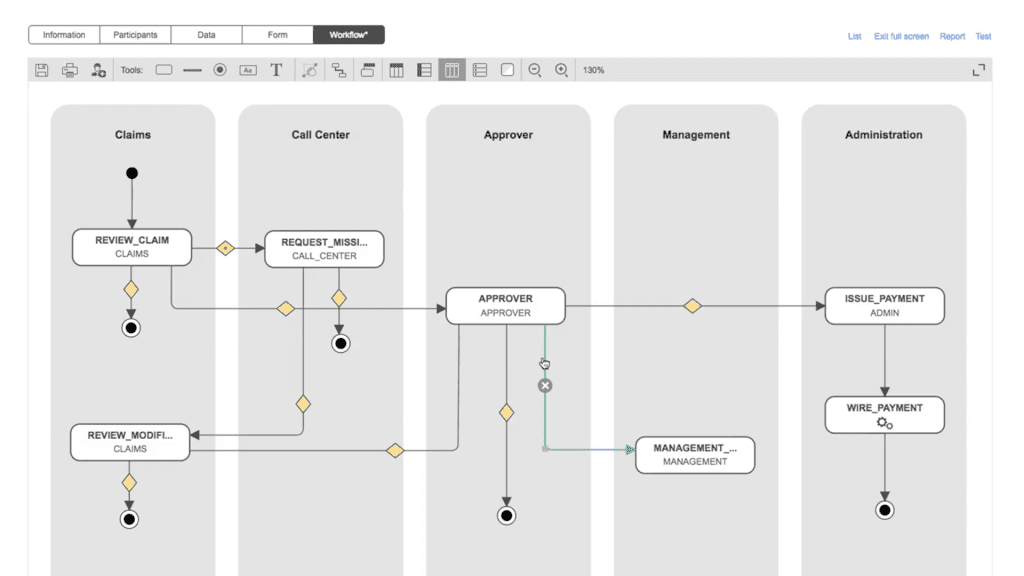
Workflowgen is a true general-purpose workflow solution, incorporating all the major features expected in the industry. Particularly noteworthy is its graphical process editor, similar to the one seen in Oriana, which also uses “drag&drop” functionality to enable process modeling without software development expertise. Although its visualization does not follow the BPMN 2.0 standard widely used in process management, it is clean and easy to follow. An advantage over several other providers is its support for swimlane diagrams, allowing us to view the process steps for each participating role separately.
The tabs at the top of the editor provide additional settings. Another user-friendly feature is the ability to edit forms in a split-screen view while keeping the process itself visible.
The real strength of the software, built using .NET Web Forms and C#, lies in its integration capabilities. The solution includes numerous ready-made connections, such as Microsoft Azure integration, which supports user authentication and the use of existing group-based permission management, access to SQL databases and file servers, and email notifications. Naturally, it also integrates with Microsoft 365 and Microsoft Graph, enabling functions such as sending emails and managing calendars through Exchange, exporting files to OneDrive or SharePoint, and organizing meetings using Teams.
To help determine whether Workflowgen is the right solution for us, both the vendor’s website and that of its Hungarian reseller list numerous multinational enterprises, alongside Hungarian organizations from the public sector and the energy, insurance and food industries. Unfortunately, neither the vendor nor the reseller provides pricing information, although this is hardly surprising for a solution specifically designed for large enterprises.
xFLOWer
We have seen examples of American workflow software available through Hungarian resellers, but it is an even greater achievement when a Hungarian-developed solution expands worldwide. xFLOWer Group is headquartered in Budapest, Hungary, but also has representation and customers in America. The group’s leading Hungarian business and the developer of xFLOWer began operating in 1996. Since 2010, under its current name, Click On Hungary Kft., it has been a leading player in Hungary’s workflow software market. Its local team of 14 helps numerous Hungarian businesses automate their processes.
xFLOWer is available both as an on-premise solution installed on local servers in enterprise environments and as a cloud-based solution. This provides a significant competitive advantage by making business process automation accessible to small and medium-sized businesses as well.
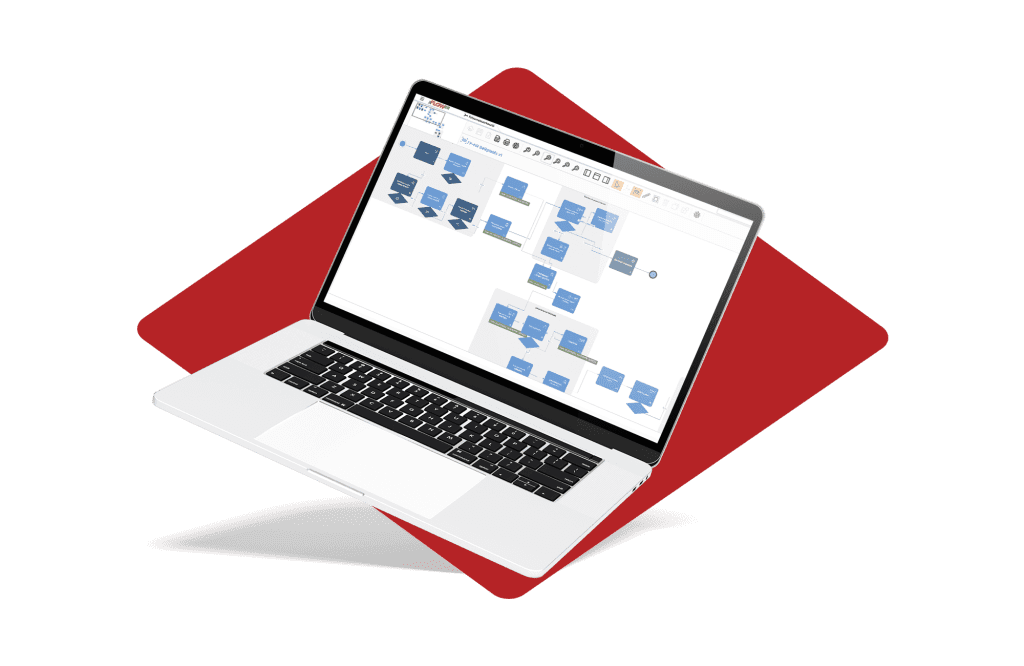
Like the solutions presented earlier, xFLOWer has a graphical process editor that is exceptionally clean while offering highly sophisticated configuration options. Although it does not use the BPMN 2.0 standard, its “drag&drop” interface makes it easy to model business processes. Compared with the solutions reviewed earlier, it enhances the user experience by allowing process steps to be configured while the process is being drawn—setting permissions, selecting forms, defining decision-point rules and more. This means we can establish the rules governing the process as we model it and test them immediately. A panel on the right-hand side of the screen allows the required data to be entered under various tabs, while the panel at the top provides the action buttons needed for editing.
xFLOWer does not support swimlane visualization, but its ability to organize process steps into groups means users are not significantly disadvantaged. Grouped elements, or steps, not only make editing visually easier but also support functions that can be applied to the entire group at once.
While its process editor is competitive with the alternatives, if not the best, we have seen more modern-looking form editors. xFLOWer does not have a graphical form editor with drag&drop functionality, but this appears to be less of a drawback than expected: users can navigate between editing tools using tabs and immediately view newly added fields on the form. In return, it offers extensive configuration options, including field-level customization, without requiring software development expertise.
There is certainly no shortage of integration options either. xFLOWer provides numerous ready-made integrations important to Hungarian businesses (Számlázz.hu, NAV Online, Ügyfélkapu, Libra, etc.), and can integrate with any existing enterprise management system or other software through API connections. It is also worth remembering that the development team is entirely Hungarian and locally based, which can be crucial in a complex integration project where communication between the parties is paramount.
As outlined above, any process can easily be built from scratch without software development expertise, placing the solution in the low-code / no-code category. Beyond this, the developer identifies numerous areas in which it offers expertise or ready-made templates, including procurement, finance, customer service, HR, legal and contract management, back-office operations and more.
Customer references are always a key consideration for IT solutions, and protecting confidential business information is an understandable reason why some customers do not consent to being named. With xFLOWer, however, prospective customers are not left guessing: the vendor’s website features numerous strong references, including multinational and state-owned enterprises (Vodafone, Auchan, Díjbeszedő Holding), utility providers, leading banks and insurers (such as Metlife, Groupama Biztosító and Aegon), financial institutions, pharmaceutical and media companies, and others. Confidence in the business is further strengthened by the many videos and other materials available on its public channels, including YouTube, covering both the solution and the company’s managing director, who speaks on business process automation at prominent conferences.
Finally, we reach another criterion in our comparative analysis that none of the Hungarian providers reviewed so far has met: public pricing on the website. This is another trust-building factor, as published prices not only make it easier to shortlist potential suppliers but also reveal the software’s pricing model. Naturally, xFLOWer also offers an all-inclusive package, typically aimed at enterprise requirements, for which the vendor provides a custom quote—an entirely understandable approach. However, Basic, Standard and Pro packages are also listed with prices and detailed descriptions of their contents. These packages and their pricing confirm our earlier hypothesis regarding the cloud offering: business process automation has also been made accessible to small and medium-sized businesses. But that is not all. Unlike most market players, the vendor uses usage-based rather than user-based licensing, determined by the number of processes initiated and documents handled in the system. This suggests that the “pay as you go” model—paying only for what you actually use—offers an affordable entry point and scalable usage for smaller businesses, without pricing out enterprises with large workforces. As the references demonstrate, many such enterprises are already taking advantage of this opportunity.
Click&Flow, Touch&Flow
Our review of Hungarian providers concludes with two solutions that share the same origins. Both were developed by GST-MAX Kft., a Budapest-based company founded in 2005, with just two employees and revenue of HUF 13 million last year. These two solutions also seek a share of the general-purpose workflow market. They offer ready-made modules for credit monitoring, liquidation, records and document management, and archiving, as well as interfaces with banking systems and multifunction printers.
Among these solutions supporting desktop and browser-based use, Click&Flow—whose name bears a striking resemblance to a competitor’s company name—was designed primarily for office environments. Alongside its process management capabilities, this is supported by features such as a Microsoft Office add-in, scanning, OCR and more.
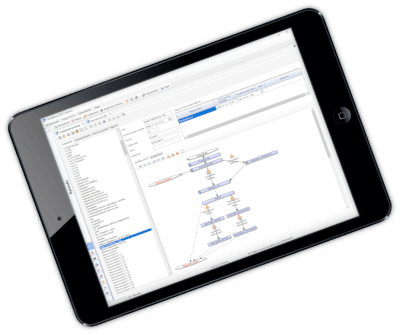
Touch&Flow is a browser-optimized product built on the foundations of Click&Flow, although it omits some of its features, such as integrations, for security reasons. Its advantage is that it runs on any device capable of using a browser. Its forms can therefore be displayed on mobile devices, which can be useful when working away from a fixed location.
Unlike the other competitors reviewed, the software developer has published manuals for its solutions on its website. While these do not cover every feature, they provide a useful starting point for deciding whether the software’s capabilities meet our requirements.
Unfortunately, we found no public customer references on the developer’s website. However, its general terms and conditions, the feature list forming an annex to the contract, and the full price list are freely available for download. Pricing follows a per-user monthly subscription model, potentially supplemented by other fees. The tiered pricing structure aims to accommodate scenarios with many users, although it cannot be described as particularly favorable for large enterprises. Small and medium-sized businesses, on the other hand, may benefit from the low entry threshold and the ability to integrate the solution into their organizations on a scalable basis.
Summary
Hungarian workflow and process automation providers offer a high standard of quality compared with their international counterparts. For organizations in Hungary, choosing a locally developed software solution can be particularly advantageous thanks to prompt, high-quality support and cost-effectiveness.
At Click On, we complement our software solution with ongoing support to ensure that business processes are designed effectively, drawing on decades of experience.