We aim to illustrate the market through the following selection of systems. This is by no means an exhaustive list, as numerous solutions are available.
n8n, Make, Zapier, ChatGPT Agents, Flowise, Microsoft Copilot Studio, xFLOWer and Appian
Introduction
In recent years, low-code and no-code platforms have revolutionized application development: today, not only developers but also business users can automate processes, connect systems and even build complete solutions.
More recently, a new era has begun: AI-powered low-code.
Artificial intelligence no longer merely supports process design; increasingly, it drives it. A prompt becomes a workflow, a question becomes a flowchart, and a decision leads to autonomous execution.
In this comparison, we examine the key players—from integration engines and AI agent systems to enterprise BPM platforms.
Scope of the Analysis
The aim of this article is not to provide an error-free, perfectly accurate comparison, but to present a comprehensive, practical overview of today's AI-powered low-code landscape.
The low-code and no-code platform market is changing extremely rapidly, with new versions, features and integrations appearing almost every week. The information presented here should therefore be viewed as a snapshot rather than a definitive verdict.
If a system has since evolved, gained new features or requires clarification, this is best understood not as an error, but as a sign of the technology's remarkable progress.
Our goal is to help professional audiences—developers, decision-makers and innovators—understand the trends and see how AI can fit into the low-code world, from integration tools to autonomous, AI-driven processes.
For these reasons, this article will inevitably contain minor errors or inaccuracies, as the systems discussed continue to evolve.
We welcome any corrections, additions or clarifications in advance. Through this overview, we aim to encourage a shared understanding of the present and future of AI-powered low-code.
Main Categories of Low-Code Systems
Integration-Centric Low-Code
- Purpose: connecting systems and automating repetitive tasks
- Examples: n8n, Make.com, Zapier
AI-Driven Low-Code / Agentic Systems
- Purpose: enabling artificial intelligence to plan processes, make decisions and execute them independently
- Examples: ChatGPT Agents, Flowise
Enterprise / BPM-Based Low-Code
- Purpose: digitalizing complex enterprise processes while ensuring compliance and data security
- Examples: Microsoft Copilot Studio, xFLOWer, Appian
Brief Introduction to the Systems
n8n
An open-source, self-hostable workflow automation system.
Popular among developers because it can be extended with JavaScript and run locally or in Docker.
Strengths: openness and flexibility.
Weaknesses: less user-friendly; AI integration is not native.
Make.com (formerly Integromat)
A cloud-based visual process builder.
A standard in the citizen developer category: thousands of application integrations and clear, easy-to-follow flowcharts.
AI integration: through OpenAI and Google AI APIs.
Drawbacks: cloud-only; costs can rise for complex projects.
Zapier
The best-known no-code automation platform.
Fast, with extensive integrations—ideal for office or marketing automation.
AI integration: built-in ChatGPT and Claude models, but limited decision logic.
Drawbacks: limited data security and enterprise support.
ChatGPT Agents (OpenAI)
The next generation: agentic AI.
The user specifies a goal in natural language, and the agent plans and executes the process independently.
Advantages: autonomous operation and context awareness.
Drawbacks: limited integration and strong cloud dependency.
Flowise AI
An open-source visual AI workflow builder based on LangChain.
Ideal for developers who want to build their own AI processes, such as chatbots or document analyzers.
Advantages: self-hostable and flexible.
Drawback: requires technical expertise.
Microsoft Copilot Studio / Power Platform
Microsoft's low-code ecosystem (Power Apps, Power Automate, Copilot) is one of the most mature AI-integrated solutions.
Copilot Studio enables users to create automations and apps using natural language.
Advantages: Microsoft 365 integration, security and enterprise support.
Drawbacks: Microsoft-centric ecosystem and high licensing costs.
xFLOWer Low-Code Platform
A BPM and workflow platform combining low-code and AI capabilities.
Designed specifically for enterprise processes, it also offers ready-made solutions for case management, procurement, HR, finance and document management.
Advantages: customizable process engine, AI integration, self-hosting and GDPR compatibility.
Drawbacks: less widely adopted internationally, with a strong presence in the Hungarian market; requires implementation.
Appian
One of the most mature players in the low-code sector, with strong enterprise workflow and AI support.
Integrated BPMN modeling, decision automation and AI analytics.
Advantages: robust, with mature compliance capabilities.
Drawbacks: complex implementation and premium pricing.
Comparison Table (Abridged)| Platform | AI Integration | Self-Hostable | Focus | Target Audience | Pricing |
|---|---|---|---|---|---|
| n8n | External API | ✅ | Integration | Developers | Free / Low-cost |
| Make.com | API | ❌ | Integration | Citizen developers | Mid-range |
| Zapier | Built-in + API | ❌ | Automation | Business users | Freemium |
| ChatGPT Agents | Native (LLM) | ❌ | AI workflow | Innovators | Mid-range |
| Flowise AI | Native (LangChain) | ✅ | AI workflow | Developers | Free |
| Microsoft Copilot Studio | Native (Copilot, Azure OpenAI) | ❌ | AI + Low-code | Enterprises | High |
| xFLOWer | Built-in + external AI | ✅ | BPM / Workflow | Enterprises | Mid-range / Custom licensing |
| Appian | Built-in | ❌ | BPM / AI Decision | Large enterprises | High |
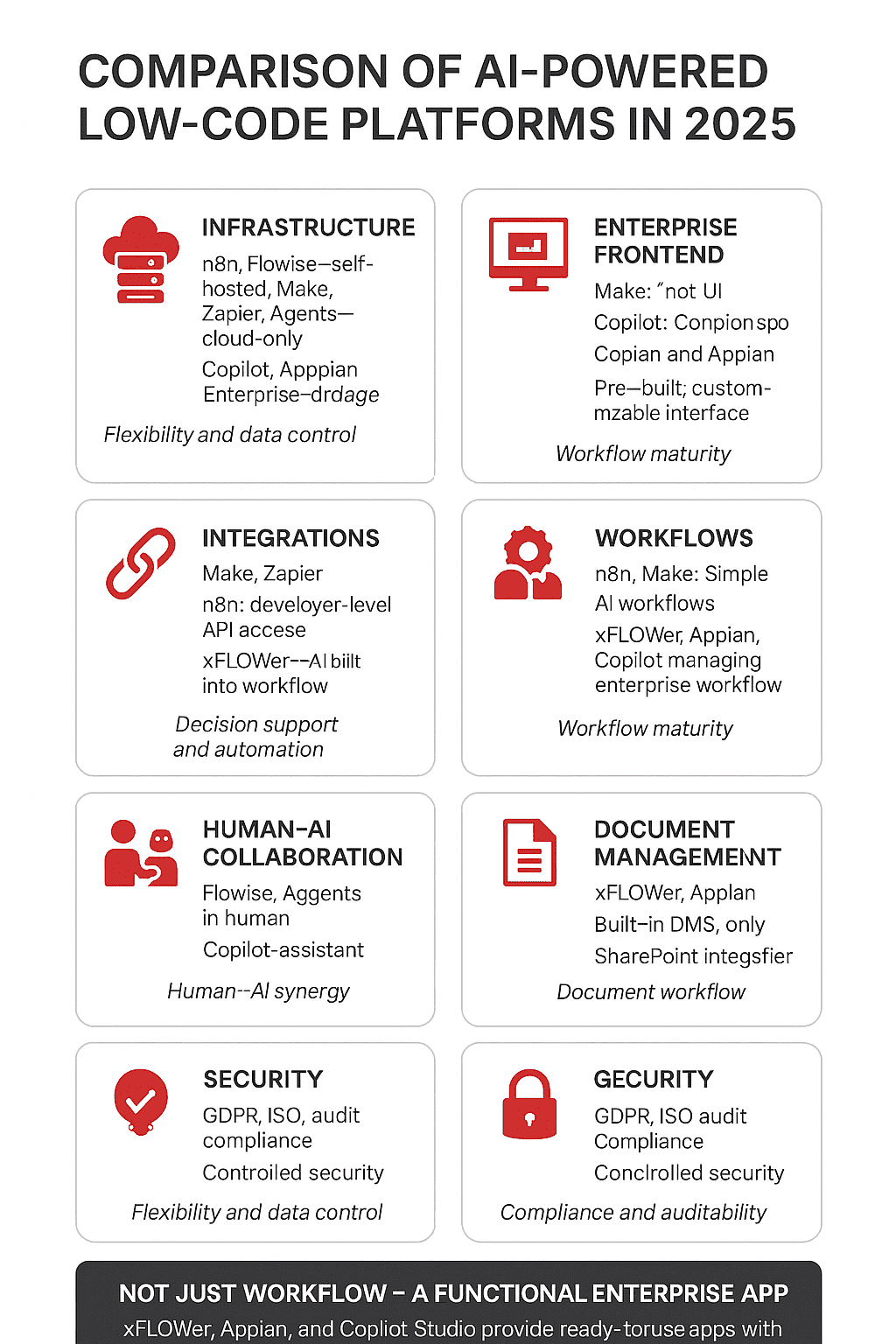
| Function / Use Case | n8n | Make.com | Zapier | ChatGPT Agents | Flowise AI | Microsoft Copilot Studio | xFLOWer | Appian |
|---|---|---|---|---|---|---|---|---|
| Infrastructure / Deployment Model | ✅ Self-hostable, including in development environments | ❌ Cloud-only | ❌ Cloud-only | ❌ Fully cloud-based | ✅ Self-hostable | ⚙️ Microsoft 365 ecosystem | ✅ Both on-premises and cloud | ⚙️ Cloud-based, with an enterprise option |
| Integrations and Data Connections | ✅ Open, with developer control | ✅ Thousands of built-in integrations | ✅ Office and marketing integrations | ⚙️ Limited API integration | ✅ Custom AI pipelines | ⚙️ Microsoft 365 integrations | ✅ Full enterprise API integration | ✅ BPMN-level integration |
| AI-Driven Decisions | ⚙️ Via external API | ⚙️ API-based | ⚙️ Limited | 🧠 Autonomous agent, independent decision-making | 🧠 LangChain-based decision-making | 🧠 Copilot-based decision-making | ✅ AI module can be integrated into workflows | 🧠 Built-in Decision Engine |
| Connecting Human and AI Processes | ⚙️ Manual trigger | ⚙️ Limited | ⚙️ Basic user involvement | 🧠 AI directs human steps | 🧠 Human–AI dialogue within workflows | 🧠 Copilot assistant embedded in the process | 🧠 Human tasks + AI decision support natively integrated | 🧠 Human–AI collaboration at BPMN level |
| Enterprise Frontend / Case Management Portal | ❌ | ❌ | ❌ | ⚙️ Console / prompt-based | ⚙️ Developer UI | ⚙️ Power Apps + Teams interface | 🧠 Ready-made, customizable case management and portal interface | 🧠 Ready-made application frontend |
| Business Process and Workflow Management | ⚙️ Basic | ✅ Visual approval flow | ⚙️ Limited to simple approvals | ⚙️ AI-assisted workflow | ⚙️ Decision-support components | ✅ Integrated approvals and app building | 🧠 Complete enterprise process management, from HR to finance | 🧠 Mature BPM architecture |
| Document Management / Generation | ❌ | ❌ | ❌ | ⚙️ Analysis modules | ⚙️ Basic document analysis | ⚙️ SharePoint integration | ✅ Built-in DMS module and document generation | ✅ Full DMS and workflow integration |
Additional Insights
The comparison clearly shows that most low-code or AI-powered platforms—such as Make, Zapier, n8n, Flowise and even ChatGPT Agents—are primarily tools for integration and connecting processes. They make it easy to build data flows, automations or simple AI processes between separate systems, but the result is generally not a standalone application, but a background process.
In contrast, xFLOWer, Appian and, to some extent, Microsoft Copilot Studio provide a complete enterprise operations layer: they not only manage processes but also offer user interfaces, permissions management, a case management portal and document management.
The key difference is that these platforms are not merely tools, but ready-made, configurable applications that can be used immediately in an enterprise environment.
AI decision-making and autonomous operation: ChatGPT Agents and Flowise are the most advanced in this area.
Integration flexibility: n8n and xFLOWer have an advantage when custom APIs or internal systems are involved.
Data security and compliance: Copilot, xFLOWer and Appian stand out.
Cost level: n8n and Flowise are ideal for development or experimentation, while Appian and Copilot are positioned at the enterprise level.
Where Is Low-Code Heading?
The new generation of low-code systems does not just execute processes—it understands intent.
Three key trends are gaining momentum:
- Agentic AI—AI makes decisions and acts on them independently.
- “AI inside” platforms—AI becomes embedded in form and process building (e.g. Copilot, xFLOWer.ai).
- Data security and transparency—demand is growing for self-hostable, auditable systems.
The low-code platforms of the future will not simply connect systems; they will provide a learning, context-aware operational framework for the entire organization.
Summary
The AI-powered low-code ecosystem is evolving faster than ever.
Zapier and Make enable rapid integrations, ChatGPT and Flowise bring a new approach to automation, while Microsoft Copilot Studio, xFLOWer and Appian are shaping the future of governed, enterprise-level processes.
Low-code is no longer (just) about automation—it is about how an organization can think alongside artificial intelligence.