By Zsolt Szederkényi
IntroductionFirst, I would like to clarify that I am not an expert in medicine or healthcare; I have only experienced how they work as a patient. This article was inspired by a professional discussion that raised the question: to what extent can medical decision-making be modelled? My aim here is to apply my experience in other areas of business to healthcare processes. If I am mistaken at any point, I welcome corrections.
A doctor can make a life-or-death decision in as little as 10 seconds. But can that decision be modelled in advance? Medical decision-making may seem chaotic, but it actually follows protocols. How can these be documented and applied effectively?
During a discussion at a BPM-H association event (the BPM-Hab networking event), the following question arose:
"A patient arrives at hospital vomiting blood. Can we show the events of the next three years as a process model?"
The answer is not as straightforward as we might think. The business process experts involved in the discussion held significantly different views.
Doctors' Lack of Time
My presentation to the director general of a large hospital lasted 1.5 minutes. I wanted to introduce him to a software solution.
He stated: "We doctors make decisions about people's lives in 10 seconds, and I cannot give you more than two minutes of my attention." The conversation ended quickly. This raises a question: if decisions are made so quickly, what logic underpins them?
(I will not go into detail about how I felt at the time.)
Technological Barriers
A process and document management project at a county hospital in 2009 failed because the assistants refused to increase their monitor resolution above 640*480. They were "used to it that way", and Word looked good at that resolution. If such a minor technological hurdle triggers this much resistance, what challenges might a comprehensive modernisation involve?
Modelling Medical Processes – Arguments For and Against
Different views clashed at the BPM-H association's event. The objections were as follows:
It is too complex
Indeed, but that is precisely why it needs to be modelled! If a process is too complicated, it should be broken down into subprocesses.
Every doctor makes different decisions
Decisions and their long-term consequences need to be documented. Medical decision-making is based on individual experience and protocols. While protocols provide general guidance, a doctor's personal knowledge and experience, together with the patient's condition, influence the final decision. Data-driven medicine is the future, but we must also recognise that differences in doctors' experience and approaches mean that modelling does not always imply full automation. AI and Big Data cannot replace medical decision-making, but they can support it with data-driven recommendations.
The process may repeat or enter a loop
- This can also be modelled! If a patient's condition improves or deteriorates, the treatment process changes, but this is still a repetition that can be modelled. Modelling must be flexible enough to accommodate changing health conditions and newly emerging factors.
AI and Workflow Systems in Healthcare
The above clearly shows that medical decisions are made amid many unknown factors. They are shaped by scientific knowledge and experience, in other words, by protocols. And if a system operates according to protocols, it can be modelled—that is, represented as a process.
As a patient, I see that certain parameters place me within a system, a protocol that determines my subsequent treatment pathway.
But what does AI say? How should high cholesterol be treated, for example? This is clearly a theoretical model, and the specific actions depend on the doctor's knowledge, experience, level of education and how up to date they are. Nevertheless, the doctor is very likely to follow a decision-making mechanism that fits a process that can be modelled.
Artificial intelligence and data-driven modelling can help us understand these processes:
Semmelweis HELP application – provides patients with recommendations based on their symptoms.
EESZT and Big Data – medical decisions could be optimised using historical data.
Workflow systems – track patient pathways and standardise documentation.
But how can we create clear flowcharts? A patient may not understand scientific protocols, but a visual process showing potential outcomes can help with decision-making.
Protocols?!
So, many decisions are made amid many unknowns… Based on experience, in other words, following medical protocols. All of this suggests that processes can be modelled. The question is: to what level of detail, and how?
As a patient, I see that certain parameters put me through a machine, so to speak—a protocol. (This is generally good for me, unless I have a condition no one else has, which is, of course, rare.)
What does AI say? How should high cholesterol be treated, for example?
Treating High Cholesterol (AI-Generated Process)
Source: xflower.ai
Prompt: Please create a medical process for treating high cholesterol.
Subprocesses!
The flowchart above can be broken down into further subprocesses, meaning that each individual step can be described in greater detail.
Let us see whether the "lifestyle counselling" step—the first on the left—can actually be represented as a process.
(As a reminder, this is where doctors give us the standard advice: a Mediterranean diet, more exercise, plenty of fluids, and so on.)
Lifestyle Counselling (AI-Generated Process)
Source: xflower.ai
Prompt: A patient has been diagnosed with high cholesterol. The doctor provides lifestyle advice. Please create a lifestyle counselling process with branches.
Loops / AI / Big Data?
I know, I know—this is where the question arises: what happens when it is time for a follow-up and the condition has improved, remained unchanged or perhaps deteriorated? What if cholesterol levels are now normal, but a source of stress has also disappeared—for example, the patient changed jobs—so perhaps it was not the medication that made the difference? Meanwhile, the patient may have developed diabetes. In that case, should treatment continue or stop?
As I mentioned earlier, I am not a doctor, but I am certain that various professional protocols exist, and are regularly updated, to take these factors into account and help determine the appropriate course of treatment.
In today's era of AI and Big Data, healthcare systems such as EESZT hold vast amounts of real patient data. This enables us to identify the best treatment pathways based not only on theories, but also on the outcomes of actual examinations and decisions.
Our task—as professionals in process control and IT—is to make these protocols accessible, suitable for automation and easy to understand. Healthcare decision-makers include not only specialists, but also general practitioners, patients, and their family members, friends and colleagues. Ultimately, patients themselves make the decision, based on the opinions of those around them and perceived or actual past experience ("My father smoked too, yet he lived to 92").
Patients decide whether to take their medication every morning, whether they are willing to exercise more, eat more healthily, or even give up smoking, alcohol, drugs, chocolate or energy drinks.
I firmly believe that a clear, visual flowchart showing expected life expectancy and quality of life at each decision point could be an effective aid to making the right decision.
Source: https://www.lifehealthcare.co.za/news-and-info-hub/latest-news/can-you-body-heal-after-smoking/
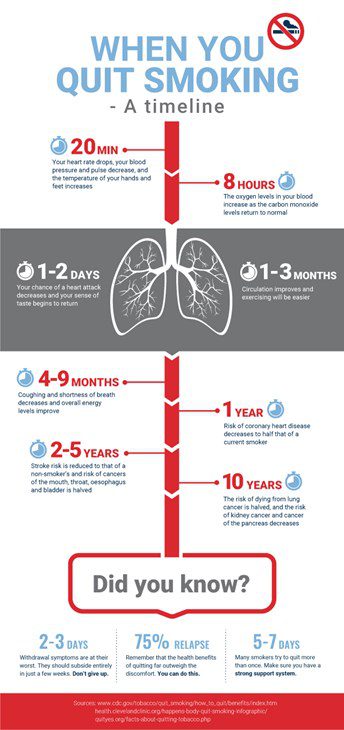
But this is not actually a flowchart? Indeed it is not, and certainly not BPMN 2.0. But at least it is easy to understand and shows our options and prospects.
We could create a flowchart too. It would contain the same information, but serve a different purpose and audience. That would be closer to a protocol, but let us stick to calling it a flowchart, because a protocol needs to be much more than this.
Quitting Smoking (AI-Generated Process)
Source: xflower.ai
Prompt:I would like to quit smoking. What process would you recommend? Include the following: - medical options -- patches -- sprays -- therapy groups -- magic -- tablets -- family -- quitting together with a spouse - scientific information -- books?
Medical Decision-Making and the Role of Process Management
Can We Support Every Medical Decision?
I firmly believe we can. Returning to the original example—a patient arriving at hospital vomiting blood—if we want to predict the possible outcomes over the next three years, we can do so.
We should not imagine a single, enormous flowchart: it would not all fit. Instead, we need to support specific points in the process:
- Decision options – what actions can the doctor or healthcare staff choose from?
- Past experience – including poor decisions, so that lessons can be learned from them.
- Scientific alternatives – including Western and Eastern medicine, and even spiritual or other faith-based approaches.
Supporting these decision points is not only possible but essential—this is what a medical protocol is. Someone who is vomiting blood cannot simply be sent home with a vitamin C tablet.
The Role of Process Management
This is where process managers come in.
By making protocols accessible and understandable to everyone involved, they can save lives, make businesses more efficient—or simply change the world.
It is important to understand that patients encounter many people before receiving hospital treatment:
- the employer who notices they have become unwell,
- the taxi driver who takes them to hospital,
- the triage nurse who admits them to the department,
- and finally the doctors, among whom an internal medicine specialist and a dentist have entirely different areas of expertise.
Everyone involved needs access to the necessary information at a level appropriate to their role.
Modern Technology in Healthcare
There are already medical case conferences where an AI Agent participates alongside doctors. It contributes to the discussion in a human voice, reviewing all test results and medical histories and studying the available protocols. (Related article: How Artificial Intelligence Could Transform Healthcare)
IBM Watson's model, for example, can provide a second opinion in oncology, even directly to patients without involving doctors. This clearly raises numerous ethical questions, but the technology is already in use. (See: meta-analysis of Watson for Oncology in clinical application)
Recently, a colleague visited a district cardiology clinic in Budapest, where a large flowchart on the wall showed the steps of resuscitation. He wanted to photograph it out of professional interest—he works in workflow management—but was prohibited from doing so without any reasonable explanation.
This also highlights the need to share knowledge, and the lack of a culture that supports doing so. There simply is not enough wall space in the world to print out every medical decision scenario and display it wherever it is needed.
That is why we need IT systems.
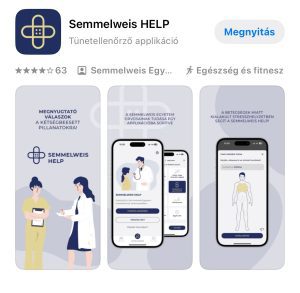
An excellent example is the Semmelweis HELP application, which guides users through the most important actions based on the symptoms they enter. Essentially, it is a workflow system—or, even if not fully one, since it does not allow users to create tickets to record historical data, for example, it still supports decision-making and can even be used to call an ambulance.
Digital solutions like these represent the future: supporting medical decision-making is not only necessary, but can also save lives.
As a patient, I see that certain parameters place me within a system, a protocol that determines my subsequent treatment pathway.
We have already seen what AI says. How should high cholesterol be treated, for example? This is clearly a theoretical model, and the specific actions depend on the doctor's knowledge, experience, level of education and how up to date they are. They may consider a wealth of data and experience… Nevertheless, the doctor is very likely to follow a decision-making mechanism that fits a process that can be modelled.
- Let me point out here that
experience = data, - or, more precisely,
experience = interpretation of data, - and more precisely still,
experience = the processed interpretation and practical application of past data.
Workflow and Process Models
Workflow systems and various applications can help doctors, patients and family members make decisions. Hospital care does not begin with the doctor, but much earlier:
-
Becoming unwell at work
-
Calling an ambulance
-
Nursing administration
-
Diagnostic examinations
Appropriate process models can help clarify the decision points relevant to each participant.
Conclusion
Medical decision-making is not a single, vast, incomprehensible process. It is based on protocols that can and should be modelled. Medical process management tools can help improve patients' quality of life and support healthcare professionals' decisions.
The question is not whether medical decisions can be modelled, but how to implement this effectively in practice.
AI: The Treatment Process for a Patient Vomiting Blood
Finally, let us ask AI how such a patient should be treated.
Source: xflower.ai
Prompt:Please create a hospital treatment process for a patient who is vomiting blood.