Autumn Challenges in Business Development – How Can Workflow and Automation Become an Advantage?
The Challenge
Autumn is a turning point for many businesses. After the summer holidays, business activity returns to full speed, the year-end push approaches, and planning for the following year begins. This period brings a number of challenges:
- projects accelerate as everyone works to achieve their annual goals,
- financial planning and cost optimization take on greater importance,
- preparations begin for new strategies, products and services,
- annual planning and preparations for next year's developments also come into focus,
- at most companies, projects launched at the beginning of the year need to be completed in autumn—ideally successfully,
- this is the time to motivate colleagues returning from their summer holidays—or let them slip into a “just get through another day” mindset. If you succeed in motivating them, and a workflow solution makes their work easy to coordinate and monitor, you can build greater momentum,
- regardless of industry, autumn is a period of renewal for most companies,
- employees face a surge in workload as they need to wrap up existing work while building for the future.
This is when many companies discover that processes previously managed manually, in Excel or through email are no longer fast enough, lack transparency and can easily lead to errors.
The Solution – The xFLOWer Perspective
During this period, workflow and automation are not just “nice to have”—they offer a genuine competitive advantage. The xFLOWer system can:
- provide transparent processes for projects and tasks,
- automate approval cycles (e.g. budgets, contracts and proposals),
- provide a central dashboard where all stakeholders can see the current status immediately,
- reduce administrative workloads so the team can focus on value-creating work during the autumn rush.
A well-implemented workflow system ensures that year-end deadlines are met through seamless collaboration rather than chaos.
Customer Example / Online Takeaway
For a Hungarian insurance company, autumn had always been a particularly critical period: numerous new product launches had to be prepared while compliance and financial processes were also being finalized. Previously, this meant a large volume of internal emails and manual checks.
After workflow implementation:
- proposals and contracts went through an automated review process,
- approval cycles were handled digitally, with defined deadlines,
- management had daily visibility into progress.
As a result, the company completed projects 30% faster during the autumn rush, while significantly reducing its error rate. The solution not only improved efficiency but also noticeably reduced employee stress.
Three Business Scenarios and the Benefits of xFLOWer
- A) If a company has been using xFLOWer or a similar system for a long time: now is the time to optimize. xFLOWer clearly highlights the weak points where significant time is lost. These are the areas where processes can be further automated and refined.
- B) If a company is currently implementing a workflow system: this is when the benefits of automation really start to become visible. The organization shifts into a higher gear, with more transparent and faster operations.
- C) If a company does not yet use a process management tool: while maintaining the status quo is an option, a rapidly changing business environment calls for a tool that guides the organization safely through change. This could be xFLOWer or any tool that makes business processes transparent, measurable and automated.
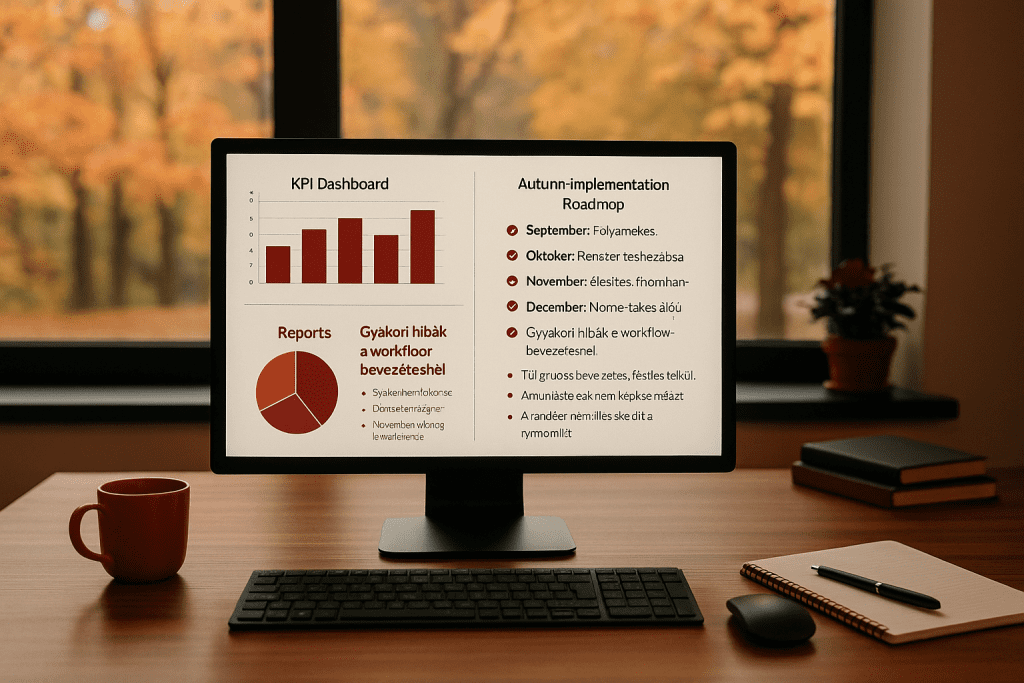
It is worth dedicating a separate section to the typical mistakes companies make during this period:
- Rushing implementation without testing.
- Failing to provide employees with adequate training.
- Introducing a system that does not fit the existing IT environment.
- Management failing to communicate the purpose of the new system clearly enough.
This would help companies avoid setbacks and plan more deliberately.
Measurement and Feedback
After implementing a workflow system, it is important to measure efficiency:
- How much time has the team saved?
- Has the number of errors decreased?
- Has the quality of customer service improved?
- Has employee satisfaction increased?
The reporting capabilities offered by xFLOWer could also be presented in this context.
The Role of Change Management
Automation is not just a technical change—it is a cultural one too. It is worth briefly addressing how to:
- involve employees,
- manage resistance,
- appoint internal “workflow ambassadors.”
This would help achieve a more successful implementation.
Integration with Other Systems
Many people are unaware that workflow systems can be connected to other tools:
- CRM, ERP and document management systems,
- email, calendars and task management tools,
- legal and compliance systems.
A brief overview of how xFLOWer can be integrated could make the system more appealing.
Autumn Implementation Roadmap
- September: map processes and define objectives.
- October: customize the system and launch a pilot.
- November: go live and fine-tune.
- December: conduct a year-end review and incorporate plans for the following year.
This would help companies think in terms of concrete steps.
A Quick Checklist for Decision-Makers
Before implementing workflow, ask yourself:
- Are at least 10 people involved?
- Are there recurring processes that can be governed by rules?
- Are transparency and reporting important?
- Is there an internal owner responsible for maintaining the system?
- Does management support digitalization?
If you answered “yes” to four or more questions, it is time to implement.
Key Takeaways and Advice
Autumn brings both opportunities and risks for every company. Businesses that establish structured, digital processes during this period can not only finish the year-end push more successfully but also build a solid foundation for the following year.
Now is the time to consider: which internal processes require too much manual work? Where do approvals, coordination and information flows break down? If workflow and automation are the answer, autumn challenges can readily become a competitive advantage.