Real Business Pain Points – and How They Become a Competitive Advantage
One of the most important lessons in business in recent years is that solutions have become commoditized. What once took years of work – designing a new process, developing an application or creating a complete business plan – can now often be achieved in days, or even hours. In the world of artificial intelligence and low-code tools, anyone can create solutions.
At first, this sounds excellent, but it has a consequence: if anyone can do it, the solution itself is no longer a source of value. It is easy to copy and reproduce.
Today, real value lies not in the solution, but in identifying the problem precisely. An urgent, real problem experienced by a customer is the new currency. This thinking is reinforced by the fact that Bosch, one of the world's largest engineering companies, now runs competitions for problems rather than solutions. They know that if the problem is well defined, a solution will follow.
Why does this matter to us? Because when we understand our customers' problems precisely, we know that xFLOWer is not simply software, but an answer to the painful everyday situations in which companies continue to lose time, money and customers.
In this article, we have collected 250 common problems we encounter across different industries. Rather than repeating itself, the list provides a comprehensive overview of where xFLOWer can make a difference – from administration to insurance and telecommunications.
The list is not exhaustive – but it is enough to show that xFLOWer can not only address these problems, but also put operations on a new footing..
Topics
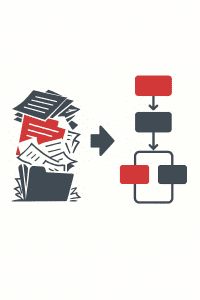
Administration and Document Management (1–25)
Administration and document management are the invisible backbone of organizations. When these processes break down, finance, HR, legal operations and customer relations can all be paralyzed.
Yet at most companies, isolated Excel lists, paper records and opaque email chains still dominate everyday work. They are time-consuming, error-prone and offer no transparency.
Below, we have listed 25 common problems that repeatedly cause difficulties at almost every company.
Document Management Errors
Error-prone manual registration of incoming documents.
This leads to duplicates and lost records.Maintaining a paper archive.
It is costly and cumbersome, with slow and inaccurate searches.Document versions get mixed up.
The wrong version is often used.Past decisions and document histories cannot be retrieved.
As a result, the same mistakes are repeated.Everyone saves templates separately.
This produces inconsistent documents.Old versions of policies remain accessible.
Employees use the wrong documents.Statutory retention periods are tracked manually.
This creates a risk of fines.
Process Bottlenecks
Deadlines are regularly missed.
There are no automatic notifications.Paper-based signature processes.
They hold up cases for days or weeks.Responsibilities are unclear.
As a result, many cases stall.It is unclear which form needs to be completed.
Unnecessary questions slow down work.Subcases are managed in Excel.
Connections are lost, making prioritization difficult.
Lack of Transparency
There is no visibility into who holds a particular case file.
This causes disputes over responsibility.There is no consistent customer or contract identifier.
Information becomes scattered.Reports are compiled manually in Excel.
They are time-consuming and full of errors.Reporting is ad hoc and time-consuming.
Managers do not receive an up-to-date overview.There is no internal audit trail.
It is impossible to prove who changed what and when.There is no clear view of how many cases are in progress.
Capacity planning is difficult.
Wasted Resources
Emails and attachments are not linked to cases.
Information is lost.The same data must be entered into multiple systems.
This creates duplicate work and discrepancies.Case handling requires many unnecessary clicks.
This takes time away from value-adding work.Document access approval is slow.
This causes unnecessary waiting.Access management is chaotic.
This poses a GDPR risk.External partners cannot access relevant documents.
This generates extra email exchanges.There is no central knowledge base.
Information is scattered, often existing only in individual employees' heads.
Finance and Procurement (26–75)
Finance Problems (26–46)
Invoices are entered into the system late.
Delayed entry can also result in missed payment deadlines.
Invoices are recorded more than once.
This creates duplicates and accounting errors.
Invoice approval is paper-based.
Obtaining signatures from multiple managers can take weeks.
Budgets are tracked manually.
It is difficult to check whether a department has exceeded its budget.
Expense claims are handled manually.
Employees submit expenses late or with missing details, making accounting unreliable.
Business travel expenses are processed on paper.
Accommodation costs, daily allowances and tickets are handled without transparency and often incorrectly.
Receivables are tracked in Excel.
There is no real-time visibility into who owes how much.
There are no automatic payment reminders.
Collection is initiated manually and is therefore often delayed.
Financial reports are prepared manually in Excel.
This is a time-consuming, error-prone process.
Project costs are not directly linked to projects.
It is difficult to see how much each project costs.
Receipts for cash expenses are submitted through scattered channels.
Cash management is incomplete and difficult to verify.
Invoicing and contract records are not connected.
As a result, invoices may be issued against invalid contracts.
Foreign currency invoices are handled manually.
Exchange rate differences lead to inaccurate statements.
Comparisons of budgeted and actual spending are delayed.
Managers do not receive an accurate view of cost centers in time.
There is no automatic bank statement import.
Every transaction must be entered manually.
Allocation across cost centers and projects happens retrospectively.
This can lead to accounting errors.
Supplier deliveries and services are not automatically linked to invoices.
This creates gaps in verification.
Storing paper accounting documents requires substantial space.
This makes retrieval and verification slow.
Contracts related to invoices are kept in separate folders.
Verification is slow and inaccurate.
Access management for financial data is unclear.
This poses a security risk.
There is no clear view of which financial documents await approval.
This slows down payments and decision-making.
Procurement Problems (47–69)
Purchase requests arrive by email.
Information becomes scattered and is easily lost.
There is no standardized procurement process.
Each department handles orders differently.
Requests for quotations are prepared manually.
This requires substantial time and administration.
Quotations are compared in Excel.
This lacks transparency and is prone to errors.
There is no central supplier database.
It is difficult to track each partner's terms.
Supplier contracts are kept in separate folders.
Commitments cannot be checked quickly.
Purchase orders arrive through multiple channels.
This makes coordination and tracking difficult.
Delivery deadlines are tracked manually.
Delays are often discovered too late.
Warehouse and procurement systems are not integrated.
Discrepancies only become apparent after the fact.
Procurement approvals are paper-based.
This slows down the entire process.
It is unclear which orders belong to which projects.
This makes cost tracking difficult.
Supplier fulfillment is checked manually.
Faulty deliveries or services can easily go unnoticed.
Procurement reports are prepared manually in Excel.
This is time-consuming and often inaccurate.
Supplier complaints are handled in separate emails.
There is no central record.
Procurement data is held in multiple systems.
This leads to duplication and discrepancies.
There are no automatic alerts for late deliveries.
Problems are only identified after the fact.
Supplier evaluations are not conducted regularly.
It is difficult to determine which partners are reliable.
There is no standardized procurement template.
Requests and orders use different formats.
Procurement decisions are undocumented.
It is unclear who selected a supplier and why.
International suppliers are managed manually.
Different legal and customs requirements create opportunities for error.
There is no up-to-date summary of procurement costs.
Managers gain visibility into spending only after a delay.
There is no central workflow for procurement processes.
Each department uses its own solution.
Procurement documents are stored in scattered locations.
This slows down verification and follow-up.
HR,
Employment Administration and Staff Outsourcing (76–110)
HR is one of the most administration-heavy functions in most organizations. Alongside traditional employment processes such as onboarding, offboarding, leave and training, many companies also face the challenge of managing outsourced staff. When these activities take place in Excel, by email or on paper, they lead to errors, delays and dissatisfaction – while also carrying significant legal and financial risks.
New-hire administration is paper-based and requires many signatures.
Documents are often lost, delaying the start of employment.
During offboarding, it is impossible to track whether employees have returned all equipment.
This can cause losses and disputes over responsibility.
Leave requests arrive by email.
They are easily lost, and there is no clear view of who is absent and when.
Onboarding is lengthy and lacks a standardized checklist.
Employees take longer to become fully productive.
Training needs are not recorded.
Many development opportunities are missed, and costs lack transparency.
Performance reviews use inconsistent formats.
This prevents comparison and long-term tracking.
Absence cover is not governed by clear rules.
Cases or projects stall when someone is absent.
Employment contract versions are managed manually.
It is unclear which version is current, creating legal risk.
The salary review process is not transparent.
Employees become distrustful when decisions lack transparency.
Sick leave documentation arrives on paper.
Processing is slow and can lead to errors.
Workplace safety training records are maintained manually.
It is difficult to demonstrate compliance during regulatory inspections.
There is no automatic notification when probation periods end.
Decisions on continued employment are therefore often delayed.
Recruitment is tracked in Excel.
Data is duplicated, and job application statuses cannot be tracked.
Applications for internal positions are handled by email.
This lacks transparency, and many promising applications may be lost.
HR reports are prepared on an ad hoc basis.
This requires extensive manual work and is not always accurate.
Employee complaints and suggestions are not processed systematically.
Feedback goes unanswered, reducing employee satisfaction.
Benefits, including flexible benefits and bonuses, are managed manually.
This causes many errors and makes the system opaque.
External workforce contracts are kept in separate folders.
This makes verification and renewals difficult.
Working time records are maintained manually.
They can be inaccurate and cause payroll disputes.
There is no automatic connection between timesheets and invoicing.
This results in extensive manual checks and delays.
Clients approve outsourced staff hours by email.
This is difficult to substantiate and delays invoicing.
Billing master data for outsourced employees is inaccurate.
This can lead to incorrect invoices and disputes.
Billing for temporary staff requires extensive reconciliation.
Manual processes cause frequent delays.
Monthly reconciliations are manual and non-standardized.
This is time-consuming and difficult to audit.
Client approvals are not recorded in the system.
In a dispute, it is difficult to prove that services were delivered.
It is impossible to track how many projects an employee works on.
This leads to overwork and inaccurate capacity planning.
HR administration consumes a disproportionate amount of time.
Fewer resources remain for strategic HR tasks.
Outsourced staffing contracts do not use a standard template.
This creates legal risk and unnecessary coordination.
Deadlines, such as medical examinations, are easily missed.
This can cause legal compliance issues.
Working time limits, such as overtime limits, are not monitored.
This can lead to employment-related fines.
Clients do not receive automatic reports on hours worked.
Clients often receive information late.
Access to HR documents is not properly controlled.
This poses a data protection risk.
Induction materials are scattered.
Employees do not consistently receive the knowledge they need to get started.
The financial performance of temporary staffing is difficult to measure.
HR and finance are not properly connected.
Employee satisfaction is measured on an ad hoc basis.
The organization does not detect declining workplace morale in time.
Legal (111–125)
The legal function plays a central role in a company: contracts, complaints, disputes and compliance. If these are not managed through digital, transparent processes, the company's exposure increases dramatically – through missed deadlines, litigation and fines.
Contracts are kept in different folders.
This makes access difficult, and the current version cannot be verified in a dispute.
There are no automatic reminders for contract renewals.
Work may continue under expired contracts, creating legal risk.
Contract amendments are not documented in the system.
In a dispute, it is impossible to trace who made changes and when.
The contract approval chain lacks transparency.
This causes delays and unnecessary coordination.
Non-disclosure agreements accumulate as separate paper documents.
They are difficult to retrieve and pose compliance risks.
Complaint records are inconsistent.
Cases are scattered, making it difficult to provide management with a comprehensive overview.
Deadlines, such as court filing deadlines, are tracked manually.
This can easily lead to missed deadlines and fines.
Monitoring legislative changes is not automated.
The organization responds late, creating compliance risks.
Litigation documents are scattered.
This obscures case status and slows down legal representation.
Regulatory investigation documents are not stored centrally.
This makes it difficult to provide information quickly and accurately.
Compliance checks are performed manually.
This creates numerous opportunities for error and a lack of transparency.
Compensation claims are managed in Excel.
This is slow and provides insufficient evidence in disputes.
Task allocation among legal staff is not transparent.
It is unclear who is responsible for a case, leading to delays.
No regular reports are prepared on the status of legal matters.
Management receives only an ad hoc view of processes.
Access to encrypted documents is not controlled.
This poses risks to data protection and trade secrets.
Insurance (126–150)
Accurate administration, customer relations and rapid claims handling are particularly important in insurance. Delays, manual coordination and a lack of transparency lead directly to customer complaints and loss of trust. Whether the service is vehicle or home assistance, or life insurance, digitalizing processes is essential.
Claims notifications arrive on paper.
This results in slow processing, and substantial information may be lost.
Claim status is not visible in real time.
Customers cannot track the progress of their cases, leading to dissatisfaction.
Documents, such as photos and police reports, accumulate in emails.
They are difficult to search and often result in incomplete files.
Vehicle and home assistance services are coordinated by phone.
This is slow, and information is easily lost.
Manual processing of medical assessments slows down the process.
This delays claims payments by weeks.
Customer complaints are managed in Excel.
Recurring problems are difficult to measure and analyze.
Monthly settlements are prepared manually.
This causes numerous errors and delays payments.
Intermediary commissions are calculated manually.
This lacks transparency and creates disputes with agents.
Customers sign contracts on paper.
The process is slow, and data may be entered into the system incorrectly.
Insurance proposals are approved by email.
This lacks transparency, and the process can easily stall.
Monthly reconciliation of life insurance policies is manual.
This is time-consuming and error-prone.
Insured events are reported through a call center.
This overloads customer service and often causes data loss.
Assistance partners' performance is not measured.
Customers may receive poor service, damaging the insurer's reputation.
Claims payment status lacks transparency.
This creates uncertainty for customers and leads to complaints.
Insurance policy amendments cannot be tracked.
This can lead to incorrect payments or gaps in coverage.
Claims assessors' work is not digitalized.
This creates extensive paperwork and delays.
Insurance reports are compiled manually.
This takes considerable time and may be inaccurate.
There is no automated connection to banking systems.
Claims payments are delayed, leading to customer complaints.
Assistance service performance is not evaluated.
Management cannot see which partners perform well or poorly.
Insurance coverage records are maintained manually.
This causes inaccuracies and creates risk.
Intermediary performance is not evaluated systematically.
Poor performers may therefore remain in the system for a long time.
Insurance fraud screening is manual.
This is slow and can result in substantial losses.
Medical expenses and invoices are processed on paper.
This leads to numerous errors and late payments.
Monthly commission and premium settlements are not prepared in a unified system.
This makes relationships with agents less transparent.
Insurance coverage is compared manually for customers.
This slows down sales and harms the customer experience.
B2C Commerce (151–160)
In consumer commerce, the biggest challenge is delivering a consistent customer experience. Behind the scenes, however, extensive administration and coordination are required: product listings, promotions and campaigns. When these activities are manual and fragmented, the impact on customer satisfaction and sales is immediate.
Product listings are created manually.
This leads to errors, slow uploads and delayed promotional launches.
Special offers and promotions are not managed consistently.
Different processes often delay campaign launches.
Campaigns are coordinated by email.
This lacks transparency and causes many misunderstandings between marketing and sales.
Marketing material approvals are delayed.
Lengthy approval processes disrupt campaign schedules.
Customer feedback is processed manually.
This slows down responses, and customer complaints recur.
Data flow between online and offline channels is inconsistent.
Conflicting data creates confusion over prices and stock.
Price lists are updated manually.
This leads to errors and inconsistent pricing communications.
Online store product data and internal inventory are not integrated.
This can lead to stock shortages or incorrect orders.
Complaint handling is not connected to the CRM.
Customer service and sales lack a unified view of customer history.
Campaign performance reports are prepared manually.
They reach management late and do not support rapid decisions.
B2B Commerce (161–170)
In B2B commerce, transparency in partner relationships, supplier processes and approvals is essential. Without digital support, orders slow down, disputes multiply and the partner experience deteriorates.
The partner database is maintained in Excel.
Data is duplicated and difficult to search.
There is no supplier portal.
Communication takes place by email, making it slow and opaque.
Orders are processed manually.
This leads to numerous errors and unnecessary coordination.
Supplier data is not synchronized with the internal system.
This causes data discrepancies and slows down order fulfillment.
Order approvals lack transparency.
The process often stalls because there is no unified workflow.
Partner contracts are scattered.
They are difficult to retrieve, leading to disputes.
The same data must be entered into multiple systems.
This creates extensive unnecessary work and errors.
Partner performance is not evaluated systematically.
As a result, poorly performing suppliers remain in place for a long time.
Partner relationship reports are prepared manually.
This delays strategic decisions.
Delivery deadlines are monitored manually.
This can easily lead to missed deadlines and customer complaints..
Telecommunications (171–185)
In telecommunications, rapid complaint and support ticket handling, together with transparent subscriber processes, is essential. When these activities are manual and fragmented, they lead to customer dissatisfaction and a competitive disadvantage.
Customer complaints arrive by email.
No support ticket is created automatically, so many cases are lost.
SLA compliance cannot be tracked in real time.
Management only sees where delays occurred after the fact.
Support ticket status is not transparent to customers.
Customers become dissatisfied because they cannot see progress toward resolution.
Internal escalations are manual.
This slows down resolution, and action is often taken late.
Information is lost when multiple organizational units are involved.
This causes delays and misunderstandings.
Customers do not receive automatic ticket status notifications.
This creates uncertainty and further complaints.
Complaint and fault types are not analyzed.
Recurring faults continue to appear.
New subscriptions are initiated on paper.
This is slow and requires extensive administration.
Subscriber contract amendments are handled manually.
This can lead to incorrect data and dissatisfaction.
Service activation takes place across multiple systems.
The different steps can make the process slow and error-prone.
Network development permits are processed on paper.
This slows down development, and cases can easily stall.
Subscriber data is entered multiple times.
This results in discrepancies and incorrect customer data.
Service termination is not automated.
Customers may continue to receive invoices after cancelling a service.
The subscriber portal is not connected to the internal system.
Customers must re-enter data, causing dissatisfaction.
No subscriber lifecycle reports are prepared.
Management cannot see customer retention and churn rates.
IT Ticketing (186–200)
Managing IT incidents and change requests is critical in every large enterprise. Without a transparent, controlled system, incidents take longer to resolve, SLAs are breached and user dissatisfaction grows. Digital ticket management should be a basic requirement, yet many organizations still lack it.
Incidents are reported by email.
No ticket is created automatically, so cases can be lost.
Ticket status is not visible in real time.
Users remain uncertain and submit follow-up inquiries.
SLA compliance cannot be tracked digitally.
Management only discovers unmet commitments after the fact.
Change requests are handled manually.
Email-based coordination lacks transparency and often stalls.
Access requests have no defined workflow.
This causes delays and poses security risks.
Incidents and change requests are held in separate systems.
This leads to fragmented information and duplicate work.
Recurring faults are analyzed manually.
This is slow, and problems continue to recur.
Priorities are not based on business impact.
Critical cases do not always receive priority.
Information is lost during handovers between departments.
This slows down resolution and causes misunderstandings.
User satisfaction is not measured after ticket resolution.
There is therefore no visibility into satisfaction with IT support.
Ticket reports are prepared manually.
This is time-consuming and often inaccurate.
Ticket documentation is inconsistent.
This makes knowledge sharing and follow-up difficult.
Escalations are handled manually.
This slows down responses and reduces customer satisfaction.
The relationship between incidents and changes is not recorded.
This creates information gaps and a lack of transparency.
The knowledge base is not connected to the ticketing system.
The same problems recur because there is no learning process.
Infrastructure Operations (201–225)
Infrastructure operations, covering IT and property, consist of many small but critical processes. When these are managed on paper or in fragmented systems, errors, delays and security risks become routine. A lack of transparency and automation directly affects safety, costs and sustainability.
Maintenance requests arrive by email.
Cases can be lost, and it is unclear when they will be processed.
There is no central asset register.
The condition of IT assets and properties cannot be tracked.
Maintenance logs are kept on paper.
This lacks transparency and makes verification during inspections difficult.
Permits are tracked manually.
An expired permit can easily result in a fine.
There is no visibility into when each asset was last maintained.
This leads to breakdowns and downtime.
Lease agreements are scattered.
This slows down renewals and can lead to disputes.
Subcontractor work is incompletely documented.
Completion cannot be verified, leading to disputes.
Escalation of critical faults is not automated.
This slows down fault resolution.
Maintenance cost control is not supported by a system.
This leads to waste and overspending.
Safety checks are performed manually.
This is unreliable and poses compliance risks.
Operations reports are prepared manually.
Management does not identify problems in time.
Maintenance tasks are assigned in Excel.
This is chaotic, and tasks can easily be missed.
The status of fault reports cannot be tracked.
Employees do not know when to expect a resolution.
Annual inspections are scheduled manually.
This can lead to delays and fines.
Maintenance costs are assigned to projects manually.
This results in incorrect data and an inaccurate financial picture.
The asset disposal process is not governed by clear rules.
This leads to waste and inventory management problems.
Property maintenance requests do not follow a standard workflow.
This results in slow processing and poor transparency.
Property-related documents are scattered.
Searching for them takes considerable time.
Network infrastructure faults are handled slowly.
This leads to downtime and customer dissatisfaction.
IT and property maintenance processes are not integrated.
This causes duplicate work and information loss.
Tenant complaints are processed manually.
This slows down responses and increases dissatisfaction.
Regulatory inspection documentation is fragmented.
This results in slow responses and a risk of fines.
Critical system availability is not monitored continuously.
This results in predictable failures that could have been avoided.
Quality checks on subcontractor work are not documented.
This leads to disputes and service quality problems.
Sustainability reports are prepared manually.
Energy and waste management data is inaccurate and time-consuming to compile.
Public Sector (226–230)
In central and local government, the greatest challenges are meeting deadlines, complying with legislation and managing documents transparently. Paper-based registration and outdated systems waste considerable time and effort.
Document registers are maintained manually.
This leads to incorrect entries and makes documents difficult to retrieve.
Citizen inquiries arrive by email or on paper.
They can be lost, and it is unclear who is handling them.
Manual tracking of regulatory deadlines is unreliable.
Deadlines are easily missed, potentially resulting in fines.
Producing reports takes weeks.
This slows down decision-making and delays management visibility.
Legally required documents are scattered.
This poses compliance risks and makes inspections difficult.
Education (231–235)
In many educational institutions, student and teacher administration, along with research documentation, is still handled on paper. This is slow, error-prone and reduces transparency.
Student requests arrive on paper.
This results in slow processing and many lost cases.
Research grant application documents are stored in scattered locations.
This makes applications difficult to track and deadlines difficult to meet.
Exam papers and official records are stored on paper.
This can cause time-consuming searches and data loss.
Publications and research achievements are recorded manually.
This lacks transparency and hinders evaluation.
Teaching materials lack version control.
Materials can become outdated, and students do not receive the latest version.
Nonprofit (236–240)
Nonprofit organizations often operate with limited resources, making process automation especially important. Tracking grant applications, funding agreements and donor communications is difficult without digital tools.
Grant application submissions are tracked using Excel lists.
This lacks transparency and is prone to errors.
Funding agreements are stored in separate folders.
This makes tracking and renewals difficult.
Donor communications are not organized systematically.
This erodes trust and makes relationships less transparent.
Reports for funders are prepared manually.
This requires substantial resources and is often inaccurate.
Deadline compliance is not supported by automation.
Funding requirements can easily be missed.
Manufacturing (241–245)
Quality management and production process administration are critical for manufacturers. When handled in Excel or on paper, they become a source of errors, complaints and disruptions.
Quality control defects are recorded in Excel.
This does not support systematic tracking and corrective action.
Customer change requests are processed manually.
This slows down manufacturing and can lead to defective products.
Machine faults are reported on paper or by phone.
This delays repairs and causes production downtime.
Production logs are kept on paper.
This results in a process that lacks transparency and is difficult to audit.
Supplier audit documentation is incomplete.
This can create compliance risks and further substandard deliveries.
Energy (246–250)
In the energy sector, safety, permits and sustainability requirements make transparent process management particularly important. Outdated administration can cause delays and fines, and may even jeopardize operational safety.
Permitting processes are paper-based.
This slows down projects and poses compliance risks.
Maintenance logs are maintained manually.
This lacks transparency and is difficult to audit.
Safety checks are documented in Excel.
This is unreliable and can cause compliance issues.
Project costs lack transparency.
Extensive manual reconciliation leads to errors and disputes.
Sustainability reports are prepared manually.
Energy and waste management data is inaccurate and becomes available late.
Conclusion
Digitalization is not technology for its own sake. It is not about introducing new systems, but about understanding our problems more deeply – and providing real, sustainable answers.
xFLOWer supports this approach: it offers not just solutions, but a new way of thinking. It helps organizations identify bottlenecks and address them through simple, transparent and automated processes.
Because the future belongs not to those with the most impressive systems, but to those who can define the right problems – and have the courage to solve them.